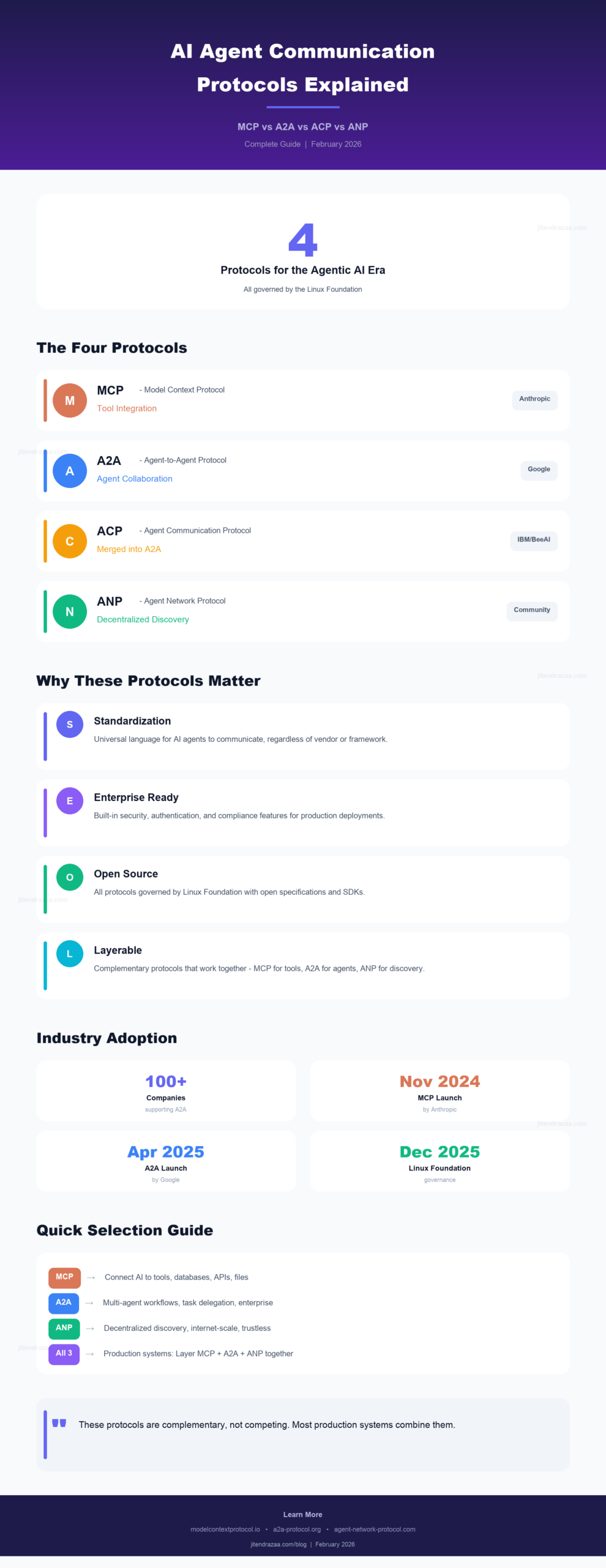
Visual overview: The 4 AI agent communication protocols and when to use each
The definitive guide to AI agent communication standards. Learn what each protocol does, when to use them, and how they work together.
Visual overview: The 4 AI agent communication protocols and when to use each
Imagine you hire four brilliant assistants who each speak a different language. One speaks French, another Mandarin, the third Hindi, and the fourth German. Individually, they're incredibly capable. Together? Chaos. They can't share information, coordinate tasks, or build on each other's work.
This is exactly the problem facing AI agents today. We have powerful AI systems from Anthropic, Google, Microsoft, OpenAI, and countless others. But without shared communication standards, these agents operate in isolation—unable to collaborate, share context, or work together on complex tasks.
Before standardized protocols, every AI application needed custom integrations for each data source. According to the Anthropic MCP announcement, this created an exponential complexity problem:
Starting in late 2024, the industry began converging on communication standards. Just as HTTP standardized web communication and USB-C standardized device connectivity, these protocols aim to standardize how AI agents interact with tools and each other.
Connects AI models to tools, data sources, and APIs. Think of it as the "USB port" for AI—a universal connector for external capabilities.
Enables autonomous agents to communicate, delegate tasks, and collaborate. Designed for enterprise multi-agent workflows.
REST-based agent messaging protocol focused on simplicity. Now merged into A2A under the Linux Foundation.
Decentralized protocol for internet-scale agent networks. Uses W3C DID standards for trustless identity and discovery.
MCP (Model Context Protocol) is an open protocol created by Anthropic that standardizes how AI applications connect to external data sources and tools. Think of it as a universal adapter that lets any AI model plug into any compatible tool—without custom integration code.
According to the official MCP documentation, the protocol replaces the N × M integration problem with a 1 × N pattern:
MCP defines three core capabilities that servers can expose to AI models:
| Primitive | Purpose | Example | Control |
|---|---|---|---|
| Tools | Executable functions for taking actions | Send email, query database, create file | Model-controlled |
| Resources | Data sources providing context | File contents, database records, API responses | Application-controlled |
| Prompts | Reusable templates for interactions | Code review template, summarization prompt | User-controlled |
Here's a complete example of a weather tool exposed via MCP:
# MCP Server exposing a weather tool
from mcp.server import Server
from mcp.types import Tool, TextContent

server = Server("weather-server")

@server.list_tools()
async def list_tools():
    return [
        Tool(
            name="get_weather",
            description="Get current weather for a city",
            inputSchema={
                "type": "object",
                "properties": {
                    "city": {"type": "string", "description": "City name"}
                },
                "required": ["city"]
            }
        )
    ]

@server.call_tool()
async def call_tool(name: str, arguments: dict):
    if name == "get_weather":
        city = arguments["city"]
        # Fetch weather data from API
        weather = fetch_weather(city)
        return [TextContent(type="text", text=f"Weather in {city}: {weather}")]
To use this server, add it to your MCP client configuration (e.g., Claude Desktop's claude_desktop_config.json):
{
  "mcpServers": {
    "weather": {
      "command": "python",
      "args": ["path/to/weather_server.py"]
    }
  }
}
Once configured, the AI can automatically discover and use the tool. When a user asks "What's the weather in Tokyo?", the AI will:
get_weather tool via tools/list{"city": "Tokyo"}MCP has seen remarkable adoption since its November 2024 launch:
In December 2025, MCP was donated to the Linux Foundation's Agentic AI Foundation (AAIF). Platinum members include AWS, Anthropic, Block, Bloomberg, Cloudflare, Google, Microsoft, and OpenAI.
A2A (Agent-to-Agent Protocol) is an open protocol created by Google that enables autonomous AI agents to communicate, delegate tasks, and coordinate actions—even across different vendors and frameworks.
While MCP connects AI to tools, A2A connects agents to each other. This distinction is crucial:
According to the A2A specification, agents communicate through these core components:
| Component | Description | Purpose |
|---|---|---|
| Agent Cards | JSON metadata describing agent identity and capabilities | Discovery & capability negotiation |
| Tasks | Stateful work units with unique IDs and lifecycle states | Track work from creation to completion |
| Messages | Communication units with role and content parts | Information exchange between agents |
| Artifacts | Task outputs (documents, images, structured data) | Deliver results of completed work |
Tasks in A2A move through defined states. Here's the complete state machine:
Here's what an Agent Card looks like—this is how agents advertise their capabilities:
{
  "name": "Document Analyzer",
  "description": "Analyzes documents and extracts key information",
  "url": "https://agents.example.com/doc-analyzer",
  "version": "1.0.0",
  "capabilities": {
    "streaming": true,
    "pushNotifications": true
  },
  "skills": [
    {
      "id": "analyze-pdf",
      "name": "PDF Analysis",
      "description": "Extract text, tables, and insights from PDF documents"
    },
    {
      "id": "summarize",
      "name": "Document Summarization",
      "description": "Generate concise summaries of lengthy documents"
    }
  ],
  "authentication": {
    "schemes": ["oauth2", "apiKey"]
  }
}
A2A has strong backing from the enterprise software industry. According to the Linux Foundation announcement:
ACP (Agent Communication Protocol) was a REST-based protocol created by IBM Research and the BeeAI team in March 2025. Its focus was simplicity—developers could use ACP with just cURL, Postman, or any HTTP client without requiring specialized SDKs.
ACP's design philosophy prioritized developer accessibility:
| Feature | ACP Approach | Benefit |
|---|---|---|
| REST-native | Standard HTTP verbs and conventions | No SDK required—works with cURL |
| Async-first | Built for long-running operations | Natural fit for AI agent workloads |
| Multimodal | Text, images, code, files in messages | Rich agent interactions |
| Framework-neutral | Works with LangChain, crewAI, AutoGen, etc. | No vendor lock-in |
ACP organized communication around four main concepts:
The merger wasn't a takeover—ACP's strengths were integrated into A2A:
ANP (Agent Network Protocol) is a community-driven protocol designed for truly decentralized agent networks. According to the official ANP website, it aims to be "the HTTP of the Agentic Web Era"—enabling agents to discover and communicate across the open internet without central registries.
While MCP and A2A excel in controlled environments (enterprises, curated marketplaces), ANP targets open, trustless networks where agents need to autonomously find and verify each other.
ANP introduces a new DID (Decentralized Identifier) method called did:wba (Web-Based Agent). This allows agents to:
| Aspect | MCP | A2A | ANP |
|---|---|---|---|
| Discovery | Manual configuration | HTTP Agent Card retrieval | Search engine indexing |
| Identity | Token-based auth | OAuth/API keys | W3C DIDs (decentralized) |
| Trust Model | Server trusts client | Enterprise boundaries | Cryptographic verification |
| Central Authority | MCP server owner | Organization admins | None required |
| Best For | Tool integration | Enterprise workflows | Open internet agents |
According to the ANP technical white paper, the protocol is still maturing:
Here's a comprehensive comparison of all four protocols:
| Aspect | MCP | A2A | ACP (Merged) | ANP |
|---|---|---|---|---|
| Creator | Anthropic | IBM/BeeAI | Community | |
| Launch Date | Nov 2024 | Apr 2025 | Mar 2025 | Jul 2025 |
| Current Status | Production | Production | Merged into A2A | Development |
| Primary Purpose | Tool integration | Agent collaboration | Agent messaging | Decentralized discovery |
| Architecture | Client-Server | Peer-to-Peer | REST-based | Decentralized P2P |
| Transport | JSON-RPC, Stdio, SSE | HTTP, SSE, Push | HTTP REST | HTTPS, JSON-LD |
| Governance | Linux Foundation (AAIF) | Linux Foundation | Linux Foundation | W3C Community Group |
| SDK Downloads | 97M+ monthly | Growing | Deprecated | Early stage |
Select the capability that best matches your use case
Let's walk through practical examples of when to use each protocol:
In practice, these protocols aren't mutually exclusive—they're complementary. The most capable AI systems layer them together:
Here's how a sophisticated enterprise might layer all protocols:
MCP (Model Context Protocol) connects AI models to tools, data sources, and APIs using a client-server architecture. A2A (Agent-to-Agent Protocol) enables peer-to-peer communication between autonomous AI agents for enterprise coordination. MCP is for tool integration, while A2A is for multi-agent collaboration. They complement each other—use MCP to give agents capabilities, use A2A to let agents work together.
Use MCP when connecting AI models to external tools and data sources (databases, APIs, file systems). Use A2A for enterprise multi-agent workflows requiring agent-to-agent communication and task delegation. Use ANP for decentralized, internet-scale agent networks without central registries. For most enterprise applications, layering MCP and A2A together provides the most comprehensive solution.
ACP was created by IBM/BeeAI in March 2025 as a REST-based agent messaging protocol focused on simplicity. In August 2025, ACP merged into the A2A protocol under the Linux Foundation, combining ACP's developer-friendly REST patterns with A2A's enterprise features. Existing ACP implementations should migrate to A2A—migration guides are available in the official repositories.
MCP was created by Anthropic and announced in November 2024. A2A was created by Google and announced in April 2025. Both protocols are now governed by the Linux Foundation—MCP under the Agentic AI Foundation (AAIF), and A2A under its own project with 100+ supporting companies including Google, Microsoft, AWS, Salesforce, and ServiceNow.
Yes, MCP and A2A are complementary protocols designed for different purposes. MCP provides the tool integration layer (connecting AI to databases, APIs, files), while A2A provides the multi-agent coordination layer (enabling agents to delegate tasks and collaborate). Many enterprise solutions layer both protocols—agents use MCP for their individual capabilities and A2A for inter-agent communication.
Reference guide for technical terms and abbreviations used throughout this article.
