Master the industry-specific CRM trusted by utilities worldwide - now in the Agentforce era - with Shivanya persona-based data model walkthrough
Reading time: ~29 minutes| Last Updated: August 2026
Article Updated: August 2026
This article has been refreshed with the latest information, including the Spring '26 Agentforce product renaming, current editions and pricing, the IDC MarketScape 2026 recognition, and Summer '26 release highlights. Originally published January 2026.
What's New in This Update (August 2026)
Added: Agentforce era coverage — Spring '26 product renaming and the Agentforce for Energy & Utilities tier at $700/user/month
Updated: Current editions and pricing — Enterprise now starts at $500/user/month
Added: IDC MarketScape 2026 — Salesforce named a Leader in AI-Enabled Utility Customer Experience Management
Added: Summer '26 release highlights — agentic scheduling console, enhanced GIS, and smarter group appointments
Updated: Data-model references aligned with the latest Salesforce developer documentation
Added: ENGIE's new Agentforce story alongside the classic Customer 360 journey
500+
Utilities (2021 IDC Assessment)
3
Data Model Walkthroughs
2026
IDC MarketScape Leader (AI-Enabled Utility CX)
$195B
Digital Utility Market (2024)
1
What is Salesforce Energy & Utilities Cloud?
Quick Answer: Salesforce Energy & Utilities Cloud is an industry-specific CRM platform that combines Sales Cloud and Service Cloud (now Agentforce Sales and Agentforce Service) with a comprehensive industry-specific data model, prebuilt processes, and integrations designed for electric, gas, water utilities, and retail energy suppliers. It enables utilities to deliver personalized customer experiences while optimizing field operations and managing clean energy programs.
According to Salesforce's official product page, Energy & Utilities Cloud is the best of Salesforce CRM designed specifically for the energy and utility industry. It gives utilities prebuilt applications with user experiences, automation, and integration designed based on industry best practices.
With the Spring '26 release, Salesforce renamed several core products as part of its Agentforce 360 branding: Sales Cloud became Agentforce Sales, Service Cloud became Agentforce Service, and Salesforce Field Service became Agentforce Field Service. Some listings now brand this product as "Agentforce Energy & Utilities", although Salesforce's own product page still titles it Energy & Utilities Cloud. This guide uses both the classic and current names where each applies.
The platform serves a diverse range of energy sector organizations:
Electric Utilities: Power generation and distribution companies managing residential and commercial customers
Gas Utilities: Natural gas distribution companies with complex metering and billing requirements
Water Utilities: Municipal and private water service providers
Retail Energy Suppliers: Competitive energy retailers in deregulated markets
Renewable Energy Companies: Solar, wind, and clean energy service providers
Why Utilities Need a Specialized CRM
The energy and utilities industry faces unique challenges that generic CRM platforms cannot address effectively. The Salesforce Help documentation explains that Energy & Utilities Cloud provides utility companies and energy retailers with industry-specific capabilities that enable them to deliver outstanding new customer experiences while increasing operational efficiency.
Key Differentiator: Unlike standard Salesforce, Energy & Utilities Cloud includes a growing library of preconfigured, extendable utility business processes that provide efficiency via automation, along with out-of-the-box integrations and APIs that connect to utility CIS and billing systems.
Industry Context
According to Cognitive Market Research, the global digital utility market size is USD 195.5 billion (2024 base year) and will expand at a compound annual growth rate (CAGR) of 9.5% from 2024 to 2031. This growth is driven by:
Grid modernization and smart meter deployments
Renewable energy transition and decarbonization goals
Rising customer expectations for digital self-service
Regulatory compliance and cybersecurity requirements
Electric vehicle (EV) adoption and distributed energy resources
2
History & Evolution: From Vlocity to Salesforce Industries
Salesforce Energy & Utilities Cloud traces its origins to Vlocity, a company founded in 2014 to build industry-specific CRM solutions natively on the Salesforce platform. In February 2020, Salesforce announced a $1.33 billion acquisition of Vlocity, which closed on June 1, 2020, and formed the foundation of Salesforce Industries. The acquisition brought key technologies including OmniStudio (low-code guided experiences), Industries CPQ (complex product quoting), and pre-built industry data models. Under the leadership of David Schmaier as CEO of the new Salesforce Industries division, the platform has continued to evolve—earning recognition as a leader in the 2021 IDC MarketScape for Utilities CX Management, launching Clean Energy Program Management in 2023, and integrating Agentforce AI capabilities in 2025. That momentum has continued into the Agentforce era: in 2026, Salesforce was named a Leader in the IDC MarketScape: Worldwide AI-Enabled Utility Customer Experience Management Solutions 2026 assessment, and the Spring '26 release brought the Agentforce product renaming across Sales, Service, and Field Service.
3
Core Capabilities & Features
Energy & Utilities Cloud provides a comprehensive set of capabilities designed to address the full customer lifecycle for utility companies. Here's a detailed breakdown of the platform's core features:
Customer Service & Agent Empowerment
According to the official Salesforce documentation, the platform empowers agents with smart, intuitive tools to get up to speed quickly and have full customer insight and next best actions at their fingertips.
Unified Agent Console: 360-degree view of customer accounts, service points, meters, and billing history
Next Best Action: AI-powered recommendations for upselling, cross-selling, and issue resolution
Automated Case Resolution: Quick answers to complex customer questions with automated approvals
Multi-Channel Support: Unified digital self-service, AI-driven chat, and integrated experiences across channels
Sales & Quoting (Industries CPQ)
The platform includes specialized quoting and pricing capabilities for energy products:
Multi-Site Quote
Create quotes for customers with multiple service locations
Commercial & Industrial accounts
Rate Configuration
Apply complex tariffs and pricing structures
Time-of-use, tiered rates
Contract Negotiation
Revise, negotiate, and e-sign contracts
No need to leave Salesforce
Order Capture
Submit orders and track fulfillment
Asset-based ordering
Incident Management
Utilities need to respond quickly to service disruptions. Energy & Utilities Cloud includes incident management capabilities built directly into the platform:
Major Incident Tracking: Stay ahead of disruptions with incident management best practices
Unified Workspace: All case, incident, customer, and asset data in one view
Outage Management: Coordinate response efforts and communicate with affected customers
Root Cause Analysis: Diagnose and resolve incidents faster with the right tools
Program Management for Clean Energy
According to the Salesforce Clean Energy announcement, the platform helps utilities manage energy efficiency, conservation, electrification, and EV charging programs:
Energy & Utilities Cloud integrates seamlessly with Salesforce Field Service (renamed Agentforce Field Service as of Spring '26) to optimize field operations:
Intelligent Scheduling: Assign the right technician based on skills, location, and availability
Mobile Work Orders: Field technicians access customer data, asset information, and knowledge articles on mobile devices
Prework Briefs: Equip technicians with essential customer and asset data before each job
Offline Capability: Complete work even without internet connectivity
Integration Requirement: Salesforce Field Service (now Agentforce Field Service as of Spring '26) is a separate Salesforce product that must be licensed in addition to Energy & Utilities Cloud. However, the integration is prebuilt and designed specifically for utility workflows.
4
Data Model Deep Dive for Architects
Understanding the Energy & Utilities Cloud data model is essential for Salesforce Architects. Let's walk through a real-world example to understand how customer data flows through the system. We'll follow Shivanya, a residential customer who owns a home and a vacation property, to see how the E&U data model stores her information.
Meet Shivanya: A Utility Customer Example
Shivanya lives in San Francisco and owns a vacation cabin in Lake Tahoe. She has electricity and gas service at both locations, plus water service at her primary home. Here's how her data is organized:
Shivanya's Utility Profile:
Primary Home: 123 Market Street, San Francisco, CA (Electricity + Gas + Water)
Vacation Cabin: 456 Pine Road, Lake Tahoe, CA (Electricity + Gas)
Billing Preference: Single consolidated bill, autopay with credit card
Core Objects: Where Shivanya's Data Lives
Object
What It Stores
Shivanya's Example Data
Consumer Account
Customer identity, contact info, communication preferences
Physical address where utility service is delivered
Premise 1: 123 Market St, San Francisco, CA 94105 Premise 2: 456 Pine Road, Lake Tahoe, CA 96150
Service Account
Active services at a specific premise, links customer to location
SA-001: Shivanya's San Francisco Services SA-002: Shivanya's Lake Tahoe Services
Service Point
Physical connection point for each utility type (electricity, gas, water)
SF Home: SP-ELEC-001, SP-GAS-001, SP-WATER-001 Tahoe Cabin: SP-ELEC-002, SP-GAS-002
Meter
Physical device that measures consumption
Electric Meter #E12345 (SF), Gas Meter #G67890 (SF), Smart Meter #SM11111 (Tahoe)
Billing Account
Payment method, billing address, billing cycle
Billing Address: 123 Market St, Payment: Visa ending 4242, Cycle: 15th of month, Autopay: Yes
Visual: How Shivanya's Data Connects
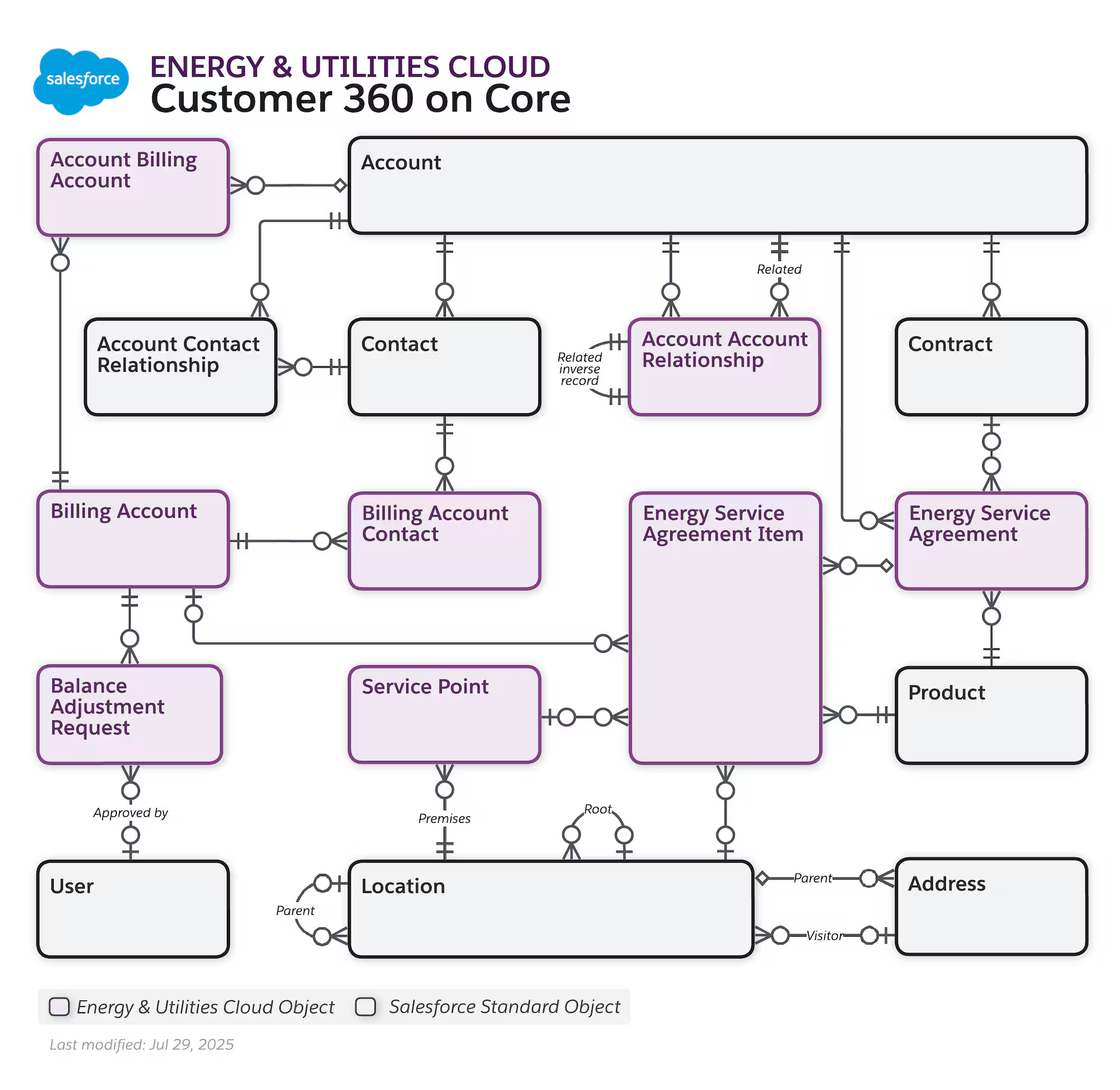
Objects such as Consumer Account, Premise, Service Account, and Meter come from the Energy & Utilities Cloud managed-package data model described in the Salesforce Help data model article. The newer Customer 360 for Energy & Utilities on core, shown in the diagram below from Salesforce documentation, models the same concepts with core platform objects: Account, Contact, Billing Account, Contract, Energy Service Agreement (and Energy Service Agreement Item), Service Point, Location, Address, and Balance Adjustment Request.
E&U Customer 360 on Core Data Model - Shows how Account, Contact, Billing Account, Contract, Energy Service Agreement, Service Point, Location, and Balance Adjustment Request objects connect on the core platform.
Source: Salesforce Developer Documentation
Real Scenarios: How Shivanya Interacts with the System
Let's see how different customer scenarios map to these objects:
Scenario
Objects Involved
What Happens
Shivanya calls to report a gas leak
Consumer Account → Service Account → Premise → Service Point (Gas)
Agent identifies Shivanya, sees both properties, Shivanya confirms it's the SF home, system locates gas service point SP-GAS-001 and dispatches emergency crew
Shivanya wants to add solar panels
Consumer Account → Premise → Service Point (Electric) → New Asset
Agent creates a new Asset record for solar installation linked to SP-ELEC-001, updates meter to bidirectional for net metering
Shivanya disputes her Lake Tahoe bill
Billing Account → Service Account (SA-002) → Meter Readings
Agent pulls meter readings for Tahoe property, compares usage patterns, creates Balance Adjustment Request if warranted
Shivanya sells her SF home
Service Account (SA-001) → Premise
Service Account SA-001 is closed, Premise remains (new owner will get new Service Account), Shivanya's Consumer Account stays active for Tahoe property
Shivanya signs up for budget billing
Billing Account → Energy Service Agreement
New Energy Service Agreement created with "Budget Billing" plan, linked to Shivanya's Billing Account, spreads annual cost into equal monthly payments
Why This Structure Matters
Key Insight: Notice how Shivanya has ONE Consumer Account but TWO Service Accounts (one per property), FIVE Service Points (one per utility connection), and ONE Billing Account (consolidated billing). This separation allows:
Shivanya to manage multiple properties under one login
The utility to track each service connection independently
Flexible billing—Shivanya could split to separate bills if needed
Property transfer without losing customer history
Business Account Example: Shivanya's Coffee Shop
Now imagine Shivanya also owns a small coffee shop. Commercial customers use a Business Account instead of Consumer Account:
Shivanya Zaa (Owner), Maria Garcia (Manager - authorized for billing inquiries)
Premise
789 Coffee Lane, San Francisco, CA 94107
Service Points
SP-ELEC-BIZ-001 (3-phase commercial electric), SP-GAS-BIZ-001 (commercial gas for cooking)
Billing Account
Business checking account, Net-30 terms, separate from personal billing
Architect Tip: Shivanya's personal Consumer Account and her Business Account are separate records, even though she's the same person. This is intentional—it keeps residential and commercial services separate for regulatory compliance, different rate structures, and tax purposes. Use the Contact object to link the same person across both account types if needed.
Extended Data Models
Beyond the core Customer 360 model, Energy & Utilities Cloud provides specialized data models for specific business functions:
Clean Energy Data Model
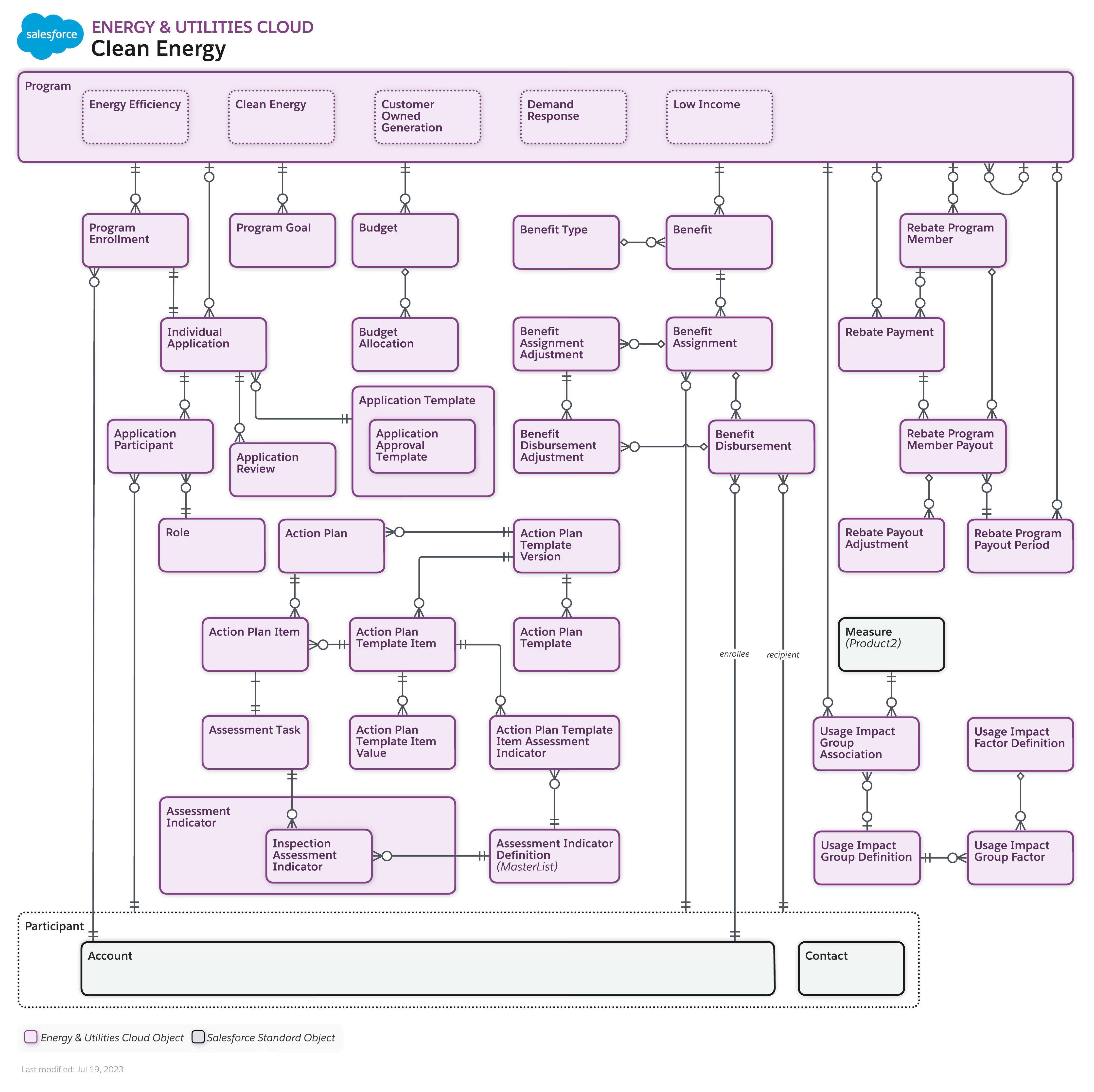
The Clean Energy data model extends E&U Cloud to support renewable energy programs, energy efficiency initiatives, and distributed energy resources (DER) management:
Clean Energy Data Model - Supports solar, EV, rebate programs, and energy efficiency initiatives.
Source: Salesforce Developer Documentation
Example: Shivanya Enrolls in Clean Energy Programs
Shivanya decides to go green at her San Francisco home. Here's how the Clean Energy data model tracks her participation:
Object
What It Stores
Shivanya's Example Data
Program
Utility-sponsored clean energy initiative
"Residential Solar Rebate Program", "EV Charger Installation Incentive", "Home Energy Audit Program"
Program Enrollment
Customer's participation in a program
Shivanya enrolled in Solar Rebate, Status: Approved, Rebate Amount: $2,500
Rebate
Financial incentive details
Rebate #RB-78901, Type: Solar Installation, Amount: $2,500, Payment Status: Pending
Energy Efficiency Asset
Installed equipment or improvement
Asset: 8.5kW Solar Panel System, Manufacturer: SunPower, Install Date: Recent
DER (Distributed Energy Resource)
Customer-owned generation or storage
DER Type: Solar PV, Capacity: 8.5kW, Net Metering: Yes, Annual Generation: ~12,000 kWh
Shivanya's Clean Energy Journey:
Step 1: Shivanya browses available Programs and enrolls in "Residential Solar Rebate Program"
Step 2: Program Enrollment record created, linked to her Consumer Account
Step 3: After installation, Energy Efficiency Asset record captures her solar panel details
Step 4: DER record enables net metering—utility tracks energy she sends back to grid
Step 5: Rebate record processes her $2,500 incentive payment
Contractor Portal Data Model
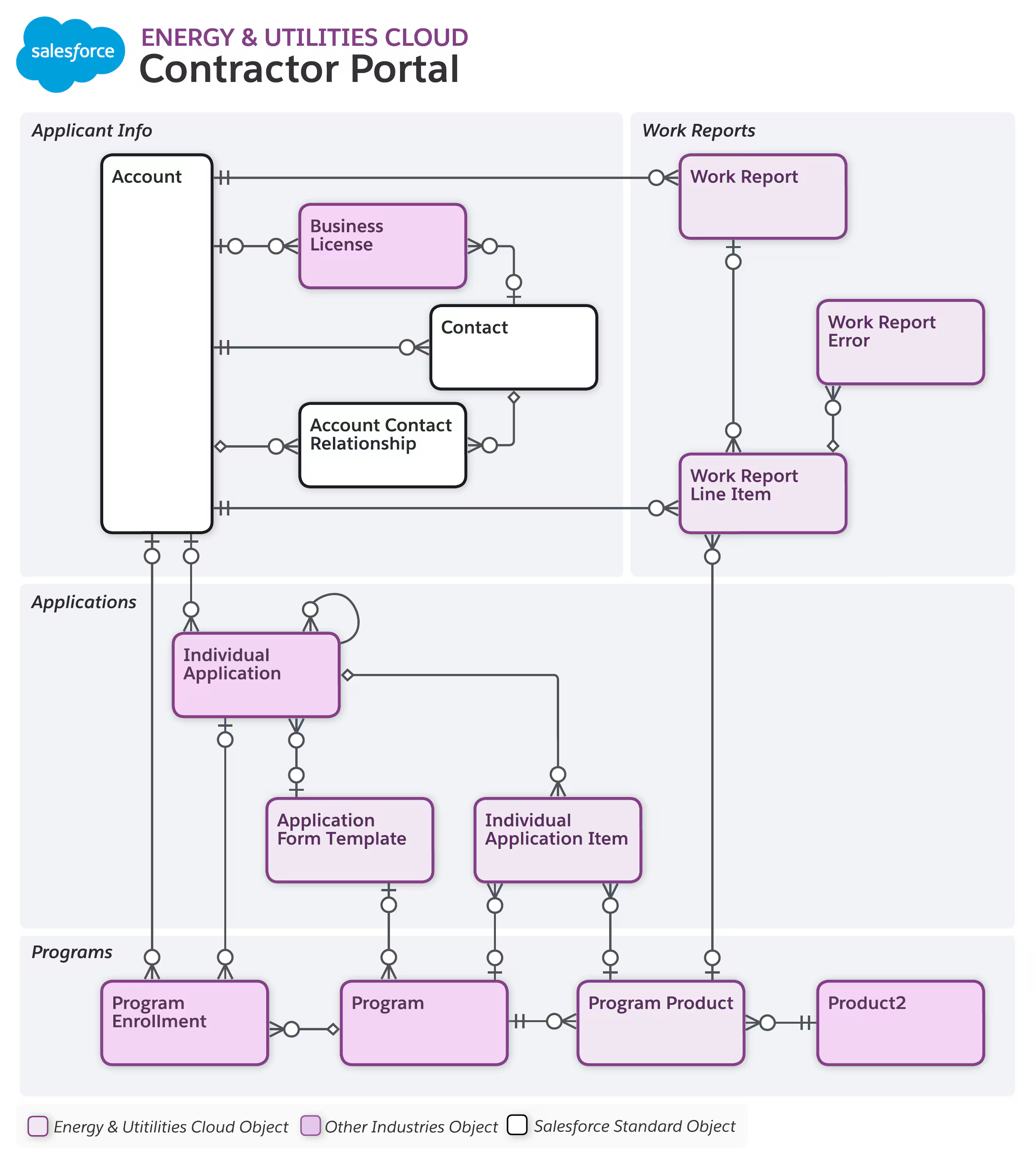
The Contractor Portal model enables utilities to manage their network of certified contractors and partner companies for installations, repairs, and maintenance:
Contractor Portal Data Model - Manages certified installers, work assignments, and partner relationships.
Source: Salesforce Developer Documentation
Example: Contractor Installs Shivanya's Solar Panels
When Shivanya's solar installation is approved, the utility assigns a certified contractor. Here's how the Contractor Portal tracks the work:
Object
What It Stores
Example Data for Shivanya's Installation
Account
Contractor company enrolled in the utility's network
Company: "Bay Area Solar Pros", utility-approved solar installer, active since 2019
Contact
People working for the contractor
Priya Sharma (Owner), lead installer on Shivanya's project
Business License
Contractor licensing credentials
License #CA-SOL-12345, Type: C-46 Solar, Status: Active
Application Form Template
Reusable template that defines a program application
"Residential Solar Contractor Application" template with required documents
Individual Application
A specific application submitted through the portal
Bay Area Solar Pros' application to install under the Solar Rebate Program, Status: Approved
Program / Program Enrollment
Clean energy program and the customer's participation in it
"Residential Solar Rebate Program"; Shivanya's enrollment, Status: Approved
Work Report
Completed work submitted by the contractor for review
WR-00456: 8.5kW solar installation at 123 Market St, Status: Submitted
Work Report Line Item
Individual tasks and materials on the work report
Line 1: Panel Installation (8.5kW), Line 2: Inverter Setup, Line 3: Permit & Inspection
How It All Connects: When Shivanya's solar installation is complete, multiple records are linked:
Shivanya's Consumer Account → links to her Program Enrollment in the Residential Solar Rebate Program
Bay Area Solar Pros (Account) → submits an Individual Application through the portal and is approved to perform program work
Work Report → filed by the contractor when the installation is complete, with Work Report Line Items capturing each task
Utility review → approval of the Work Report triggers rebate processing
Energy Efficiency Asset → created upon completion, linked to Shivanya's Service Point
Rebate → processed and paid to Shivanya after inspection passes
5
OmniStudio & Industries CPQ
OmniStudio and Industries CPQ are foundational technologies that came to Salesforce through the Vlocity acquisition. They provide low-code tools for building industry-specific experiences and complex product configurations.
OmniStudio Components
According to the Salesforce Industries documentation, OmniStudio (styled "Omnistudio" in current Salesforce documentation) includes the full package of low-code tools:
Component
Description
Use Case
OmniScript
Guided, step-by-step experiences for users
Service enrollment, move-in/move-out flows
FlexCards
Dynamic, data-driven UI components
Customer 360 views, billing summaries
Data Mapper
Transform data between systems
CIS integration, meter data normalization
Integration Procedures
Server-side integrations and orchestration
Real-time billing lookups, payment processing
Calculation Procedures
Complex business logic and calculations
Rate calculations, rebate eligibility
Industries CPQ for Utilities
Industries CPQ is specifically designed for the complexity of utility products and pricing. According to Salesforce Trailhead, OmniStudio tools support customization, integration, and automation of Industries CPQ, including guided selling flows and call scripts for sales agents.
Key Industries CPQ features for utilities include:
Rates and Pricing Administration: Complex tariff management including time-of-use, tiered, and demand charges
Multi-Site Quote and Order Capture: Handle commercial accounts with many service locations
Promotions and Discounts: Apply promotional pricing and volume discounts
Asset-Based Ordering: Manage orders for physical equipment like smart thermostats and solar panels
Headless Commerce APIs: Enable digital self-service through external portals
Pricing & Catalog Note: Salesforce Pricing for Industries CPQ and Product Catalog Management (PCM) for Energy & Utilities Cloud shipped in the Winter '25 era and are Generally Available. As of the current Summer '26 release, they remain the strategic direction for pricing and catalog management on the platform. Consult your Salesforce account team regarding licensing implications.
6
Agentforce AI Integration
Salesforce's 2025 strategy centers on Agentforce, the platform for deploying autonomous AI agents across the enterprise. According to the Agentforce for Energy & Utilities page, this solution is designed to improve operational efficiency, boost customer satisfaction, and optimize employee experience for energy and utilities organizations.
What is Agentforce for Energy & Utilities?
Agentforce Energy & Utilities is an agentic AI solution deeply integrated with your energy and utility data, metadata, and knowledge base. The platform combines several AI technologies:
Generative AI: Natural language understanding and generation for customer interactions
Predictive Analytics: Forecasting demand, identifying at-risk customers, and optimizing operations
Autonomous Agents: AI that can take actions and make decisions within defined guardrails
Retrieval-Augmented Generation (RAG): Access and integrate relevant data for informed decisions
Key Use Cases
Agentforce can be applied across multiple utility functions:
Function
AI Application
Business Impact
Customer Service
Handle inquiries, provide usage insights, offer energy-saving tips
Reduced call center volume, improved satisfaction
Grid Operations
Real-time grid monitoring and control, demand forecasting
Optimize energy storage, implement dynamic pricing
Better integration of distributed resources
Field Service
Route optimization, job recommendations, parts prediction
Faster resolution, fewer truck rolls
Atlas Reasoning Engine
At the core of Agentforce is the Atlas Reasoning Engine, which employs multiple LLMs and specialized modules to enhance reasoning capabilities. According to Salesforce's documentation, it utilizes techniques such as RAG to access and integrate relevant data and metadata, allowing agents to make informed decisions based on comprehensive context.
2025 Agentforce Milestones
According to Salesforce's 2025 recap, several key developments have shaped the Agentforce platform:
AgentExchange Launch: The world's first agent marketplace, enabling partners and developers to participate in the $6 trillion digital labor market
119% Agent Growth: The first Agentic Enterprise Index showed significant agent adoption in H1 2025
Agentforce 360: Full suite of apps, AI, and data solutions debuted at Dreamforce '25
Agentforce Voice: Voice-enabled AI agents for phone interactions
Major Partnerships: Integrations with OpenAI, Anthropic, Stripe, Google, and AWS
Industry Adoption: According to the MuleSoft 2025 Connectivity Benchmark Report, 93% of IT leaders plan to deploy autonomous agents within two years, and nearly half already have. The energy and utilities sector is among the early adopters due to the complexity of customer interactions and operational requirements.
Building Custom Agents
Businesses can build agents using Agent Builder with existing Salesforce Platform tools:
Prompts: Define agent behavior grounded in trusted enterprise data
Flows: Create automations that agents can execute across any system
MuleSoft Connectors: Connect agents to external systems and data sources
Topics and Actions: Define what agents can understand and do
7
Customer Success Stories
Salesforce Energy & Utilities Cloud has been deployed by major energy companies worldwide. Here are detailed case studies demonstrating real-world impact.
ENGIE: Global Energy Leader
According to Salesforce's official case study, ENGIE has been a Salesforce customer since 2010. In 2016, the French energy company decided to eliminate business processes that weren't sustainable in a zero-carbon world.
ENGIE Results:
50% reduction in agent training time
50% reduction in coding required (France and Belgium)
2.3X faster implementation
1.7X increase in sales opportunities during COVID-19
9-month digital transformation completion
Marc Lallemand, CIO of ENGIE Belgium, stated: "To aid the global energy transition to zero carbon and help our B2B and B2C customers better manage energy efficiency and achieve more value, Engie invested in digital technologies like Salesforce Energy and Utilities Cloud to go digital faster."
The implementation included:
Salesforce Industries: Automated processes and digital-first customer experience
Service Cloud and Field Service: 4,000 field technicians with mobile access to customer data
MuleSoft: Integration for intelligent job prioritization
Clean Energy Solutions: Prebuilt functionality for EVs, solar panels, and green initiatives
Recent development: ENGIE's journey has continued into the agentic era. Salesforce now features an ENGIE Agentforce customer story, with AI agents giving customers instant answers to their questions alongside the classic Customer 360 transformation.
British Gas: Customer Experience Transformation
According to Computer Weekly (as covered in 2019), British Gas has used the Vlocity Energy & Utilities Cloud service (now Salesforce Industries) to power its digital transformation journey across sales, marketing, and customer care organizations.
Rory Briggs, Product Owner and Commercial Manager at British Gas, noted: "We have been able to put the customer at the center of every business decision and we've maintained our market position in an increasingly competitive market."
British Gas made a strategic decision to upgrade its operating model to offer highly personalized energy offerings that combine commodity and non-commodity products.
Centrica Business Solutions
Salesforce reports that British multinational energy provider Centrica Business Solutions went live with Salesforce Energy & Utilities Cloud in just three months, demonstrating the platform's rapid deployment capability for organizations ready to transform.
Vistra Corp
Salesforce reports that Texas-based Vistra Corp used Salesforce Energy and Utilities Cloud to roll out a cross-channel, 360-view of the customer. This enabled call center agents to ensure utility customer satisfaction with every interaction by having complete visibility into customer history, preferences, and account status.
Finding More Case Studies: Salesforce maintains a comprehensive customer stories database that can be filtered by the "Energy and Utilities" industry to find additional case studies and implementation examples.
8
Implementation Best Practices
Implementing Energy & Utilities Cloud requires careful planning and a phased approach. Based on industry experience and successful deployments, here are best practices for Salesforce Admins and Architects.
Phase 1: Discovery & Assessment
Current State
Map existing CIS, billing, and field service systems
Data flows & integrations
Use Cases
Prioritize business processes
Service, sales, field ops
Data Quality
Assess customer & premise data
Migration readiness
Integration
Define real-time vs. batch needs
CIS, billing, MDM
Phase 2: Design & Configuration
Key design decisions for Energy & Utilities Cloud implementation:
Design Area
Considerations
Recommendation
Data Model
Leverage standard objects vs. custom
Use E&U Cloud objects; extend only when necessary
Integration Pattern
Real-time billing lookups vs. batch sync
Real-time for customer-facing; batch for analytics
OmniStudio vs. Flows
When to use OmniScript vs. Screen Flow
OmniScript for complex guided experiences
CPQ Approach
Industries CPQ vs. Salesforce CPQ
Industries CPQ for utility-specific pricing
Phase 3: Development & Testing
Configure Standard Components: Start with out-of-the-box FlexCards, OmniScripts, and processes
Extend as Needed: Clone and customize standard components rather than building from scratch
Integration Development: Build MuleSoft or native integrations for CIS connectivity
User Acceptance Testing: Involve customer service agents and field technicians early
Over-customization: Building custom objects when standard E&U objects exist
Ignoring OmniStudio: Using only Flows when OmniStudio provides better utility workflows
Big Bang Approach: Trying to implement all features at once vs. phased rollout
Underestimating Integration: CIS integration is complex; plan adequate time
Skipping Training: OmniStudio has a learning curve; invest in developer training
9
Pricing & Editions
According to the official Salesforce pricing page, Energy & Utilities Cloud is available in Enterprise and Unlimited editions, with an Agentforce for Energy & Utilities tier for agentic AI. Prices below are as of August 2026, per Salesforce's published pricing; contact Salesforce for quotes.
Available Editions
Edition
Price (per user/month)*
Key Inclusions
Enterprise — Service
$500
Agentforce Service (Service Cloud) capabilities with the E&U industry data model, OmniStudio, and Industries CPQ
Enterprise — Sales
$575
Agentforce Sales (Sales Cloud) capabilities with industry-specific quoting and data model
Enterprise — Sales + Service
$600
Combined sales and service capabilities on a single E&U platform
Unlimited
Contact Salesforce
Expanded platform limits, premier success resources, and full E&U capabilities
Agentforce for Energy & Utilities
$700
Agentic AI for E&U: autonomous agents grounded in your utility data, metadata, and knowledge base
*Prices as of August 2026, per Salesforce's published pricing; contact Salesforce for quotes tailored to your organization.
What's Included
All editions include core Energy & Utilities Cloud components:
Industries CPQ: Rates and Pricing Administration, Quoting, Multi-site Quote and Order Capture
Prebuilt Processes: Move-in/out, rate changes, service requests
Additional Products to Consider
Add-On
Purpose
When to Include
Agentforce Field Service
Mobile workforce management
Field technician scheduling and dispatch
Experience Cloud
Customer portals and communities
Self-service account management
MuleSoft
Enterprise integration platform
Complex CIS and billing integrations
Data Cloud
Customer data platform
Advanced segmentation and personalization
Agentforce
AI agents
Automated customer service and operations
Pricing Note: Pricing information is provided for reference purposes only and is subject to change. Contact Salesforce directly through their official website for detailed pricing and licensing discussions specific to your organization's needs.
10
Future Roadmap & Industry Trends
The energy and utilities industry is undergoing rapid transformation, and Salesforce is continuously evolving Energy & Utilities Cloud to meet emerging challenges.
AI-Powered Operations: Intelligent automation for grid management and predictive maintenance
Digital Twins: Virtual replicas of grid infrastructure for simulation and optimization
Sustainability Analytics: Advanced tools for carbon tracking and renewable energy optimization
Hybrid Cloud: Secure, scalable infrastructure for managing distributed energy resources
What to Watch Going Forward
Key Developments to Monitor:
AgentExchange Growth: Third-party AI agents for utility-specific use cases
Data Cloud for Utilities: Unified customer data platform for personalization
Green Energy Analytics: Carbon tracking and sustainability reporting
Voice-Enabled Service: Agentforce Voice for utility customer support
Partner Ecosystem: Expanding integrations with AMI, GIS, and OMS vendors
11
AI & Emergency Preparedness in Energy
As utilities increasingly adopt AI-powered platforms like Salesforce Energy & Utilities Cloud, the role of artificial intelligence in emergency preparedness and grid resilience becomes critically important. The integration of AI across utility operations is transforming how energy companies prepare for, respond to, and recover from emergencies.
IBM's Perspective on AI in Energy
In a recent analysis, IBM explores how AI and watsonx technology are helping energy companies improve emergency preparedness. According to IBM's product blog on AI emergency preparedness, advanced AI capabilities are essential for modern utility operations.
Key AI Capabilities for Energy Emergency Preparedness:
Predictive Analytics: AI models analyze weather patterns, historical data, and grid conditions to predict potential outages before they occur
Resource Optimization: Intelligent dispatch systems ensure crews, equipment, and resources are positioned optimally before and during emergencies
Customer Communication: Automated systems provide real-time updates to affected customers through multiple channels
Grid Recovery: AI-assisted restoration planning identifies the fastest path to restore service to the most customers
Asset Health Monitoring: Continuous monitoring of critical infrastructure enables proactive maintenance before failures occur
Combining Salesforce E&U Cloud with AI
When Salesforce Energy & Utilities Cloud is combined with advanced AI technologies, utilities gain a comprehensive platform that addresses both customer engagement and operational resilience:
The combination of customer relationship management from Salesforce and operational intelligence from AI creates a foundation for utilities to build resilient, customer-centric operations that can withstand and quickly recover from extreme weather events and grid emergencies.
?
Frequently Asked Questions
Salesforce Energy & Utilities Cloud is an industry-specific CRM platform built on Salesforce that provides utility companies and energy retailers with prebuilt applications, automation, and integrations designed for energy industry best practices. It combines Sales Cloud and Service Cloud capabilities (rebranded Agentforce Sales and Agentforce Service in Spring '26) with a comprehensive industry-specific data model, enabling utilities to manage customer service, billing, field operations, and clean energy programs on a single platform.
Salesforce Energy & Utilities Cloud is offered in Enterprise and Unlimited editions. As of August 2026, per Salesforce's published pricing, Enterprise starts at $500/user/month for Service, $575/user/month for Sales, and $600/user/month for Sales and Service combined, while Agentforce for Energy & Utilities is $700/user/month. Unlimited edition pricing is quote-based. Each edition includes core E&U Cloud features like Industries CPQ and OmniStudio, and add-ons such as Field Service, Experience Cloud, and Data Cloud require separate licensing. Contact Salesforce for a quote tailored to your organization.
Vlocity was acquired by Salesforce for $1.33 billion in a deal announced in February 2020 that closed on June 1, 2020, and was rebranded as Salesforce Industries. Vlocity's Energy & Utilities solution became Salesforce Energy & Utilities Cloud. The core technology, including OmniStudio, Industries CPQ, and the industry data model, remained the same but is now fully integrated into the Salesforce platform. Existing Vlocity customers were migrated to Salesforce Industries with continued support and enhancements.
Agentforce for Energy & Utilities is Salesforce's AI-powered solution that combines autonomous AI agents with the Energy & Utilities Cloud platform, offered at $700/user/month as of August 2026 per Salesforce's published pricing. It provides predictive analytics, automated customer service, real-time grid monitoring, and personalized energy-saving recommendations using generative AI technology. Built on the Atlas Reasoning Engine, Agentforce can handle customer inquiries, predict equipment failures, optimize field service routes, and manage demand response programs autonomously.
Major energy companies using Salesforce Energy & Utilities Cloud include ENGIE (global energy leader with operations in 70+ countries), British Gas (one of the UK's largest energy suppliers), Vistra Corp (Texas-based utility), and Centrica Business Solutions. Per the 2021 IDC MarketScape assessment, more than 500 utilities worldwide use Salesforce for customer management, and in 2026 Salesforce was named a Leader in the IDC MarketScape for AI-Enabled Utility Customer Experience Management Solutions. These organizations leverage the platform for customer service transformation, field operations optimization, billing integration, and clean energy program management.
Related Reading
Continue your Salesforce Industries learning journey with these related guides: